Food in Literature
Little House in the Big Woods by Laura Ingalls Wilder
A good book will transport you to another land. Reading can take you to any place or to any time without leaving the comfort of your favorite reading chair.
Many travelers will tell you that no trip to another place is complete without sampling the food. Food is essential to life. But it’s more than that. Food is unique to different cultures. Food brings people together.
It’s been said, and I agree, that re-reading a good book is like visiting an old friend. There have been times when I can’t get enough and wish I could soak up the very essence of the story I’m reading. For me, reading is essential to life. Stories are unique to different cultures. Stories bring people together.
I want to take these ideas a step further by combining them. I want to experience the food that some of our favorite characters eat in their stories. After all, no trip is complete without tasting the food from that culture.
Johnny cakes from Little House in the Big Woods by Laura Ingalls Wilder
I started reading Laura Ingalls Wilder’s Little House series when I was a kid. The Little House books were my first chapter books and I never stopped loving them. Although I didn’t know it at the time, I can reflect back and see that Laura influenced my love for reading and my love for American history. When I think of the Ingalls family, I recall that food was sometimes scarce for them. Yet despite its scarcity (or perhaps because of its scarcity), the food scenes I can recall off the top of my head, so many years later, are vivid and fun. I remember obsessing over wanting to make molasses candy in snow like Laura and Mary do in Little House in the Big Woods. My mom was likely annoyed with me since we lived in a warm region of Southern California. But my little mind was set and, to this day, I want to make molasses candy in the snow. Alas, I likely never will because I still live in San Diego, plus my diet restrictions don’t make the effort seem worthwhile. But there’s nothing preventing me from making certain other foods mentioned in the books.
One such food, an American classic, is Johnny cakes. Supposedly, they were a favorite of George Washington’s and were popular into the Civil War era, although they may have known them as something else. They’re sometimes also called Shawnee cakes, journey cakes, hoe cakes. No one really knows how they became Johnny cakes. Evidently, the name has been a mystery for many years. One of the times Laura mentions it in the Big Woods, she says, “Laura always wondered why bread made of corn meal was called johnny-cake. It wasn’t cake. Ma didn’t know….” She goes on to theorize why it might be called that. But no matter what it’s called or why, it’s part of America’s history, so I decided to make it.
In the Big Woods, Laura mentions that Ma made cracklings “to flavor the johnny-cake later.” I don’t eat cracklings, but I will eat bacon on occasion so I substituted cracklings for bacon.
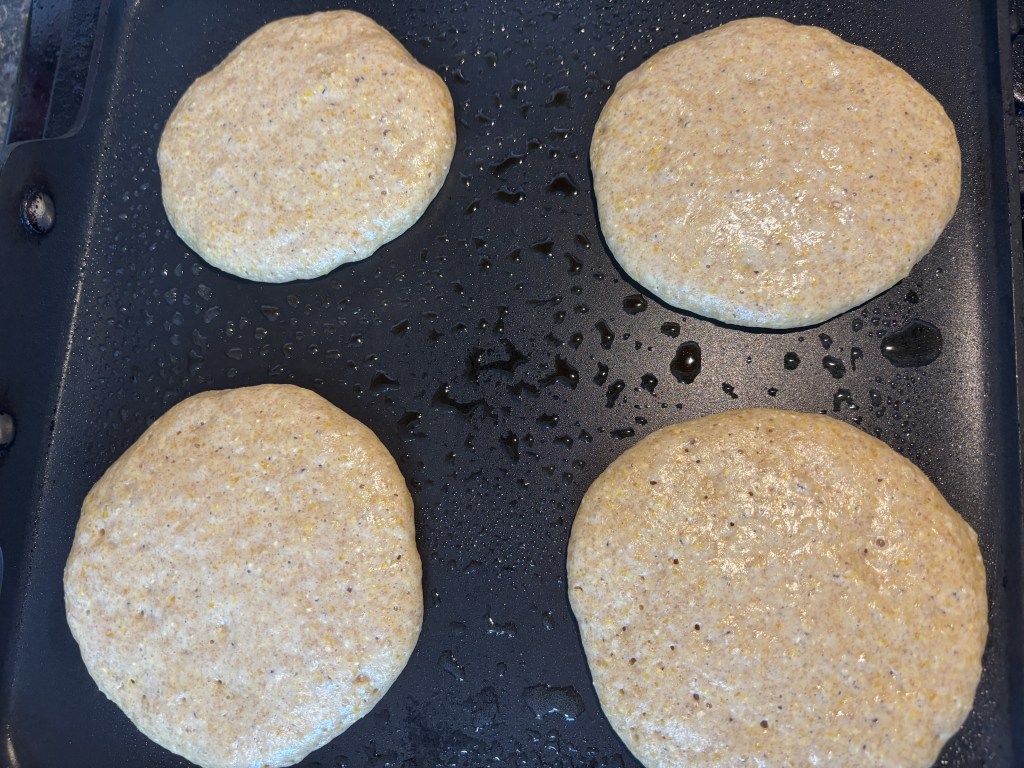
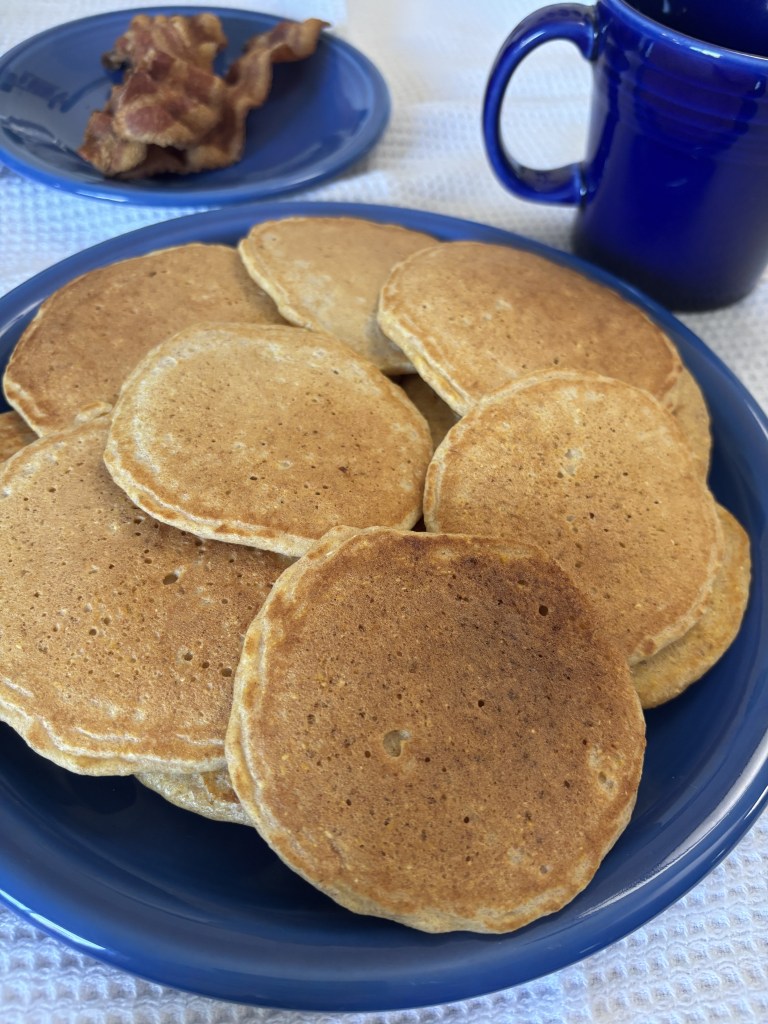
I also cooked mine in a skillet although Ma baked hers in an oven. “A big kettle of cabbage and meat was boiling on the stove; a big pan of beans and a johnny-cake were baking in the oven.” One day I may try baking them in the oven and see how those are. I picture them turning out more like cornbread instead of pancakes.
Some people suggest topping Johnny cakes with maple syrup but unfortunately it’s not part of the diet. I only ate mine with bacon and eggs. But I loved them! They exceeded my expectations. Next time I plan to try them with ham and red-eye gravy. I’ve never actually had red-eye gravy, though, so I technically don’t know how that’ll be. It sounds good though.
And, of course, I was thrilled to know that I was eating a piece of history, specifically from Laura Ingalls Wilder’s Little House in the Big Woods.
What makes it diabetic friendly?
Johnny cakes are made from a blend of flour (I used whole wheat) and cornmeal. Both are high in fiber meaning they’re digested slowly helping to prevent blood sugar spikes. But be careful, they’re still carbs. Too much will still cause a spike. Be aware, too, that the amount of carbs in each cake depends on how big you make them. If you stick to the 1/4 cup, you should make about 16 cakes, which equals about 14-15 carbs apiece. Use your best judgement and calculations to determine the amount of carbs in your Johnny cakes.
Johnny Cakes
Ingredients
- 1 cup whole wheat flour
- 1 cup cornmeal
- 2 tsp baking powder
- 1/2 tsp salt
- 2 large eggs
- 3/4 cup buttermilk
- 1/2 cup water
- 1/4 cup melted butter
Directions
In a medium bowl, whisk together the flour, cornmeal, baking powder, and salt.
In a separate large bowl, whisk together the eggs, buttermilk, water, and melted butter.
Add dry ingredients to the wet, stirring until just combined.
Heat oil or butter in a skillet over medium heat. Add about 1/4 cup of batter for each cake to the pan.
Cook until bubbles form and the edges are golden brown. Flip with a spatula and cook until the under-side is golden brown.
Variations
Johnny cakes, like pancakes, can be sweet or savory. Some possible savory additions include: onions, jalapeños, chives, cheese. Substitute buttermilk for coconut milk.
Make it a meal
Johnny cakes can be served at any meal.
- Treat them as pancakes (without the maple syrup) (1 serving carb) for breakfast with eggs and ham, bacon, or sausage (protein)
- Or treat them as cornbread for lunch or dinner. Serve with meat and cabbage as Ma did in Little House in the Big Woods
- Serve with chili or stews or hearty soups (check for carbs in soups)
- Serve with pulled pork or pulled chicken (beware of hidden sugar in that bbq sauce); or grilled chicken or fish; or pot roast (proteins)
- 8 oz glass of milk (1 serving carb)
- Serve with vegetables such as collard greens, green beans, homemade coleslaw (beware of hidden sugar in store-bought coleslaw), zucchini and tomatoes, or side salad (watch for hidden carbs and sugars in dressings)

 My GD
My GD 